


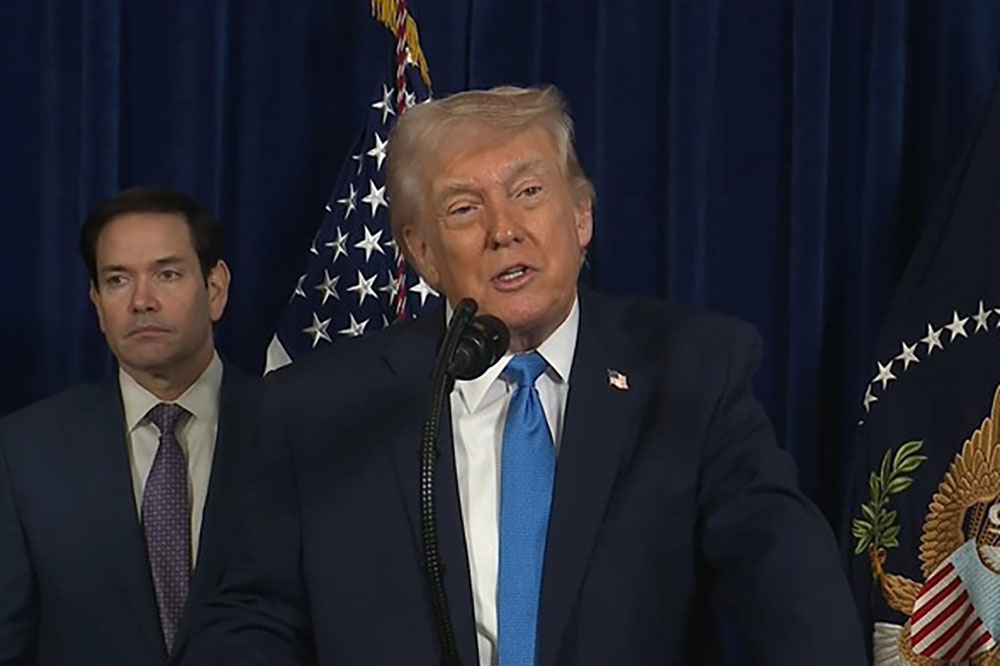

President Donald J. Trump announced on January 3, 2026, that U.S. military forces successfully carried out a coordinated overnight operation in Caracas, Venezuela, resulting in the capture of Venezuelan President Nicolás Maduro and his wife, Cilia Flores. According to official Pentagon reporting released today, the extraction marks a significant escalation in U.S.–Venezuela relations with far-reaching geopolitical implications.
In a press briefing following the mission, President Trump described the action as a decisive strike against a regime accused by U.S. authorities of corruption, narcotics trafficking, and threats to regional security. Maduro and Flores were taken into U.S. custody and transported to American territory, where they are expected to face federal charges.
The sudden operation — reportedly involving U.S. special forces alongside air and naval assets — came after months of escalating military pressure and strikes on Venezuelan territory under what U.S. officials characterized as efforts to dismantle narcotics trafficking networks linked to Maduro’s government.
President Trump said the United States would temporarily administer Venezuela during a transitional period until a stable governance structure can be established. He emphasized that the objective is a “safe and proper transition,” though details and a timeline for U.S. oversight remain unclear.
The announcement has triggered divergent reactions domestically and internationally. In Caracas, Venezuelan government figures denounced the attack as a violation of national sovereignty, with Vice President Delcy Rodríguez rejecting claims of a legitimate transfer of authority and calling for Maduro’s immediate release.
International responses have been sharply polarized. Some world leaders condemned the military action as a breach of international law and an act of aggression. At the same time, specific regional figures cautiously welcomed the removal of Maduro but urged adherence to diplomatic norms.
Legal experts and members of the U.S. Congress have raised constitutional concerns over the administration’s use of force without prior congressional authorization. Critics argue the operation may set controversial precedents for executive power in foreign interventions.
In the streets of Caracas and cities worldwide, the news sparked both protests and celebrations as communities reacted to the dramatic shift in Venezuelan leadership. Pro-Maduro supporters rallied against what they termed imperialist interference, while some Venezuelan expatriates and political opponents expressed hope for change.
The capture of a sitting head of state by foreign military forces represents a rare and historically significant act, the likes of which have broad implications for U.S. foreign policy, hemispheric relations, and global norms regarding sovereignty. Continued developments in Caracas, Washington, and international diplomatic forums are expected to shape the next chapter of this unfolding story.
— The White House (@WhiteHouse) January 3, 2026