


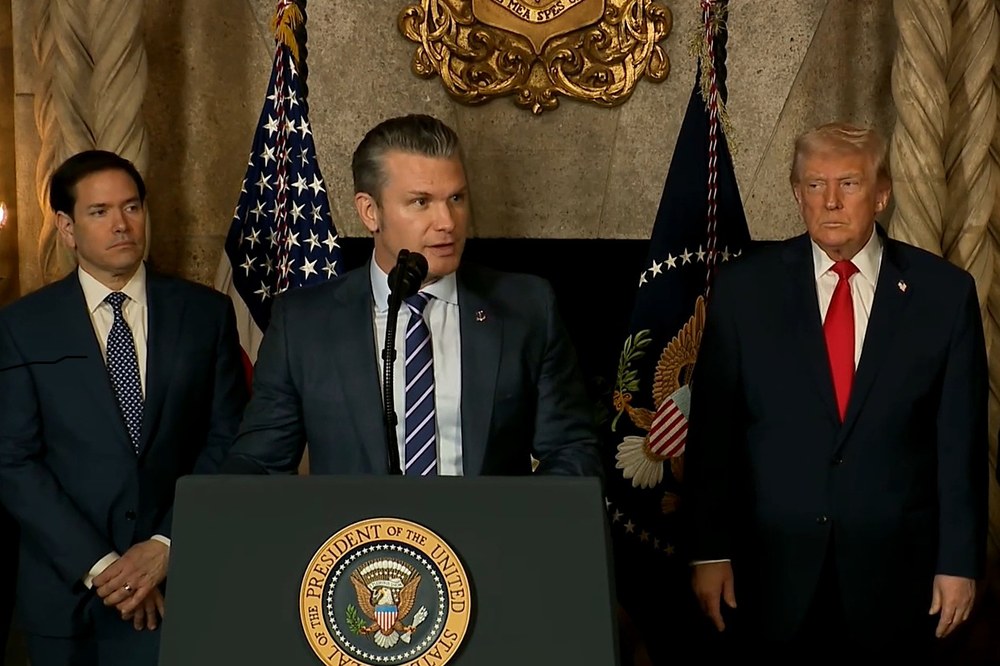

On December 22, President Donald J. Trump announced plans for the U.S. Navy to develop a new class of American-designed battleships, signaling a major shift in U.S. naval strategy and shipbuilding priorities.
Speaking from his Mar-a-Lago residence in Palm Beach, Florida, Trump said he had approved a plan for the Navy to begin construction of two new large surface combatants, each expected to displace between 30,000 and 40,000 tons. The vessels would be the largest warships built by the United States to date.
“As commander in chief, it’s my great honor to announce that I have approved a plan for the Navy to begin the construction of two brand-new, very large battleships,” Trump said during the announcement.
The president was joined by Secretary of State Marco Rubio, Secretary of War Pete Hegseth, and Navy Secretary John Phelan.
According to Trump, the ships will form the foundation of a new “golden fleet” of advanced U.S. warships. The Trump-class battleships are currently in the design phase, with construction of the first vessel, the USS Defiant, targeted for the early 2030s. The Navy ultimately aims to field between 20 and 25 ships in the class.
Phelan said the new battleships represent a critical capability the Navy urgently requires. He described the future USS Defiant as the largest, most lethal, and most versatile warship operating anywhere in the world’s oceans.
He also drew comparisons to the Iowa-class battleships that served as a cornerstone of U.S. naval power throughout much of the 20th century.
“The Iowa was designed to go on the attack with the biggest guns, and that’s exactly what will define the Trump-class battleships: offensive firepower from the biggest guns of our era,” Phelan said, adding that the new vessels would be designed not only to intercept threats but to eliminate their sources.
Hegseth framed the announcement as central to the War Department’s broader objectives, including restoring the warrior ethos, rebuilding the military, and reestablishing deterrence.
“American strength is back on the world stage,” Hegseth said. “The announcement of a golden fleet anchored by new battleships marks a generational commitment to American sea power.”
Trump emphasized that construction of the Trump-class ships would take place entirely within the United States and rely on American labor. He said the program is expected to create thousands of domestic jobs while strengthening the U.S. defense industrial base.
In terms of capability, the new battleships are expected to be equipped with traditional naval guns and missile systems, as well as hypersonic weapons, electronic rail guns, and high-powered laser-based defenses. The Navy will lead the design effort while partnering with private-sector defense contractors.
The Trump-class program will replace the Navy’s previous plan to develop a next-generation destroyer known as DDG(X). Navy officials said many of the advanced capabilities envisioned for that platform will instead be incorporated into the new battleships.
The U.S. Navy last deployed battleships in combat during the 1991 Gulf War, when the Iowa-class USS Missouri and USS Wisconsin provided naval gunfire support against Iraqi positions along the Kuwaiti coast.
The announcement follows a separate Navy decision on December 19 to proceed with FF(X), a new class of frigates intended to replace the canceled Constellation-class program, underscoring a broader reassessment of the U.S. surface fleet composition in response to evolving global threats.