


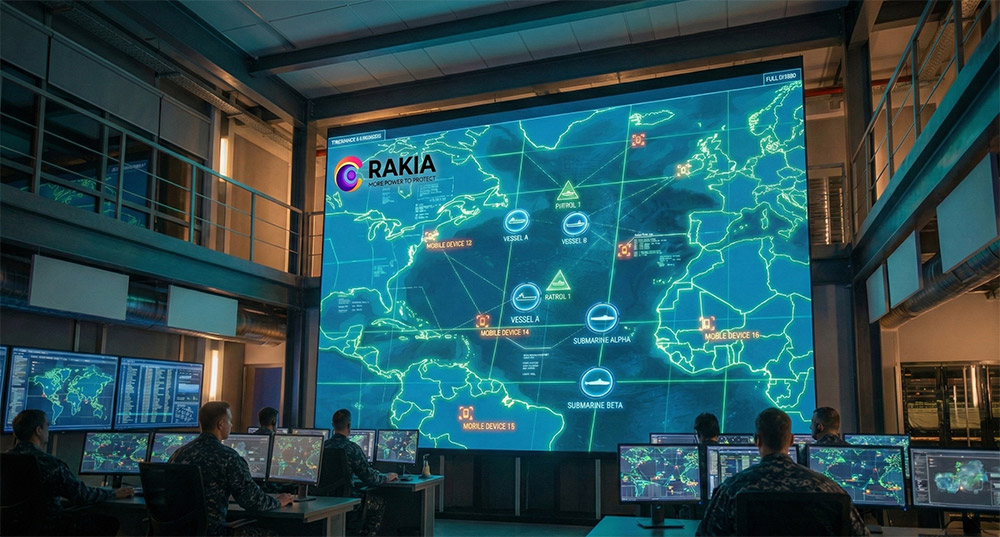

The front line in modern counter-trafficking is no longer defined by a single border crossing or an isolated maritime corridor. It exists within the noise itself.
For decades, the public narrative surrounding counternarcotics and transnational crime focused on familiar imagery: speedboats, concealed compartments, remote airstrips. Those methods still exist. However, the operational reality has shifted. Contemporary criminal networks deliberately operate within the same digital environments used by the general public. They embed themselves in encrypted communications, public social platforms, commercial logistics systems, and the routine flow of global connectivity.
In this environment, the central challenge is not whether governments can collect information. They can. The critical question is whether institutions can connect disparate signals quickly enough, lawfully enough, and accurately enough to meaningfully reduce harm.
With nearly two decades of experience across intelligence-related technologies spanning cyber operations, data fusion, and investigative analytics, RAKIA Group focuses on a defining challenge of the current era: detecting criminal patterns across fragmented data streams while remaining within strict legal, ethical, and civil-liberty boundaries. This balance is not incidental. It is precisely why the ongoing shift in defense technology and artificial intelligence markets warrants attention.
Recent international coverage increasingly highlights how defense technology firms and AI startups are being drawn into counter-trafficking missions. Platforms originally designed for conflict environments or strategic competition are now being adapted for interdiction, investigative support, and cross-domain situational awareness. This trend represents more than a business evolution. It reflects a policy response to adversaries that innovate faster than traditional institutional frameworks.
The hide-in-the-crowd strategy
Modern traffickers exploit the same technologies that enable privacy and efficiency in daily life. Encryption safeguards journalists, activists, families, and businesses, while simultaneously shielding criminal activity. Public platforms facilitate legitimate mass communication, yet also provide cover for coded signaling. Global shipping and travel systems drive international commerce while enabling concealment at scale.
A persistent misconception is that sophisticated criminal organizations hide by becoming invisible. In practice, many do the opposite. They generate volume. They create noise. They distribute activity across multiple channels to ensure redundancy. This strategy exploits a fundamental weakness of both human and automated systems: the difficulty of separating meaningful anomalies from background activity.
As a result, traditional rules-based detection methods struggle. Static models may identify past behaviors but fail against adversaries that adapt continuously. This limitation underscores the operational importance of fusion approaches, not as marketing language, but as a practical methodology. Individual data points rarely tell a complete story. Patterns emerge only when weak signals are connected across domains and over time.
What fusion means in practice
Fusion is not a claim of omniscience. It is an engineering discipline focused on reducing decision latency.
A trafficking network’s footprint is rarely confined to a single system. Indicators may appear separately in maritime movements, mobile activity, open-source behavior, and logistics patterns. None of these alone establishes criminality. Together, they can surface patterns worthy of human investigative attention.
This is the practical role of AI in contemporary counter-trafficking: anomaly detection and prioritization. The objective is not to replace analysts or investigators. It is to reduce false leads and surface high-value signals early enough to enable lawful intervention. Achieving this requires systems capable of ingesting diverse data sources, aligning them, and identifying correlations that human teams can evaluate.
Equally important is transparency about limitations. No model can replace contextual judgment, legal authority, or accountability.
The governance line that cannot be crossed
As advanced technology becomes more integrated into law enforcement and national security missions, public concern about mass surveillance is justified. The only credible response is constraint by law, oversight, and deliberate system design.
RAKIA Group operates under a clear principle: no hacking and no access to private communications. The focus remains on legally permitted data and analytical methods that identify patterns rather than intrude on privacy. Any insight generated by technology requires human review before operational use.
This distinction is not rhetorical. It defines whether a system reinforces democratic governance or undermines it. In this domain, “human-in-the-loop” must be literal, supported by documented review processes, audit trails, escalation thresholds, and clearly assigned responsibility.
Governments also bear responsibility. Procurement alone does not constitute policy. Agencies deploying powerful analytics must establish and enforce clear frameworks defining permissible use, prohibitions, and mechanisms for addressing errors.
The operational reality: people still matter
Technology can compress timelines, but it cannot replace human work.
Counter-trafficking efforts depend on investigators, analysts, prosecutors, and cross-border coordination. Even when a system flags a credible anomaly, human expertise is required to validate findings, construct investigative logic, and determine lawful and proportionate action.
When technology is treated as a substitute for staffing, outcomes degrade into dashboards rather than results. This risk is amplified by market dynamics, where funding platforms is often easier than investing in training, retention, and investigative capacity. Yet it is human expertise that converts signals into impact.
From signals to outcomes
When fusion technology is deployed effectively, its value is measured in outcomes rather than theory.
By integrating dozens to hundreds of data sources across maritime activity, communications patterns, logistics flows, and open-source indicators, RAKIA’s platform has supported government partners in identifying trafficking routes that were previously fragmented or undetectable. These insights have contributed to operations disrupting large-scale drug shipments, exposing human trafficking networks, intercepting illicit weapons flows, and dismantling organized criminal logistics corridors.
The relevance is global. Trafficking networks operate across borders, as do the patterns that reveal them. Fusion enables authorities to understand how activity in one region connects to financing, coordination, or movement elsewhere, replacing isolated alerts with actionable context. Throughout this process, technology augments human judgment rather than displacing it, preserving accountability at every stage.
Why public visibility matters
Public understanding of modern trafficking has not kept pace with reality.
Popular portrayals often depict traffickers as isolated criminals or localized gangs. In reality, contemporary networks function as transnational enterprises. Proceeds from narcotics trafficking extend far beyond street-level crime, funding weapons acquisition, territorial control, violence, and, in some cases, collaboration with designated terrorist organizations.
Illicit finance moves alongside drugs and people, flowing through the same global systems used by legitimate commerce. These financial streams enable extortion, assassinations, forced recruitment, and regional destabilization. Harm occurs throughout the supply chain, from production and transit to enforcement clashes and internal power struggles. In certain regions, the human toll rivals or exceeds the visible impact in destination markets.
Public visibility is therefore essential. Understanding the full scope of trafficking networks and their consequences is necessary for informed policy, sustained political will, and responsible oversight of the tools used to counter them.
Why this shift will accelerate
Two forces continue to drive the convergence of defense technology and counter-trafficking missions.
First, threat ecosystems are merging. Networks involved in narcotics, weapons, human trafficking, and illicit finance increasingly share infrastructure, tactics, and enabling technologies. Fragmented responses are ineffective against integrated adversaries.
Second, governments are redefining national security harm. The societal cost of trafficking is not measured solely in seizures, but in downstream violence, corruption, loss of life, and institutional destabilization. As these impacts gain political visibility, demand grows for faster and more integrated capabilities.
The real test: legitimacy
The success of fusion technology in counter-trafficking will not be judged solely by detection rates. It will be judged by legitimacy.
Systems that deliver results at the expense of public trust will face legal, political, and operational constraints. By contrast, systems designed with clear boundaries, disciplined data practices, and accountable decision-making can reduce harm while reinforcing confidence in lawful enforcement.
Traffickers have learned to hide within the same digital environments used by everyone else. Governments are responding by seeking tools capable of identifying patterns within that noise. The opportunity is substantial, as is the responsibility.
If this market expands without governance, it risks mission creep and public backlash. If it grows with governance by design, it can deliver impact while preserving the legal and ethical constraints that define legitimate enforcement.
That boundary will define the next phase of counter-trafficking technology and determine how it is ultimately judged.
By Omri Raiter, Founder and CEO of RAKIA Group