


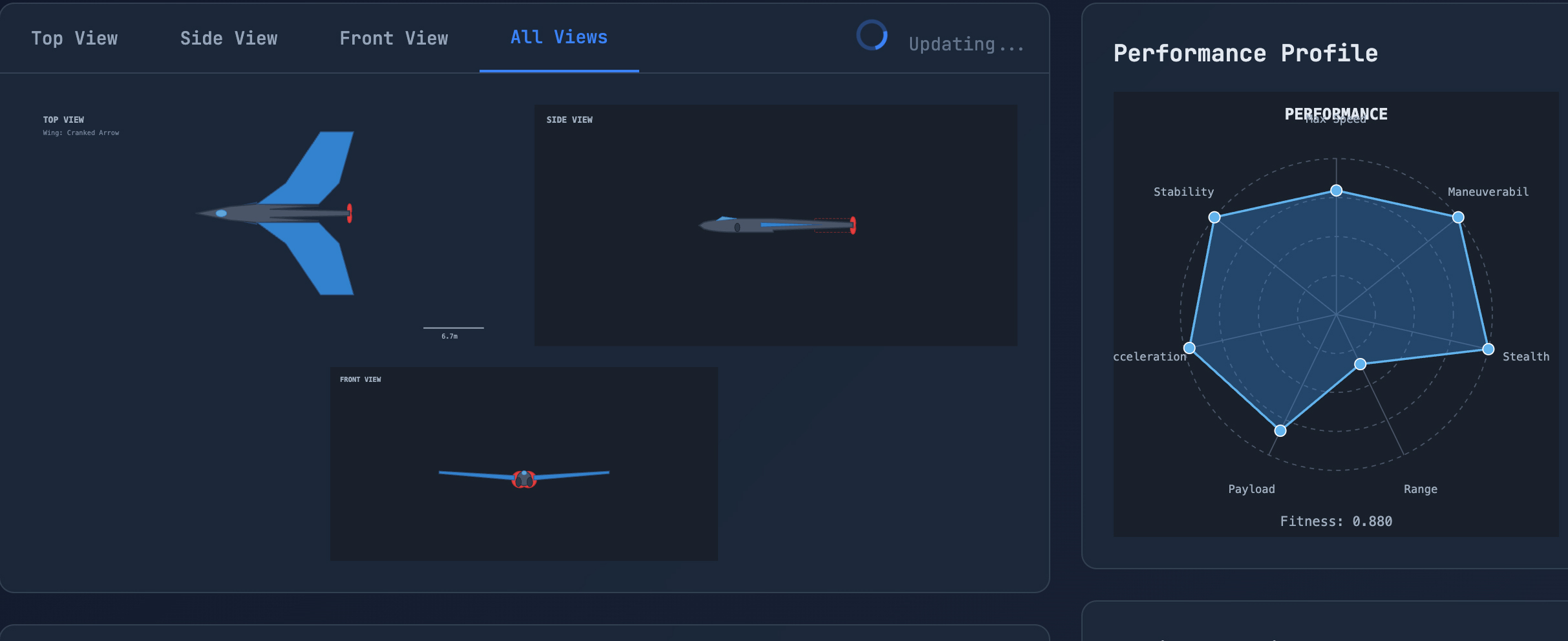

A research team at the Hong Kong University of Science and Technology (HKUST) has developed AlphaJet, an artificial intelligence framework capable of autonomously designing fighter aircraft configurations through advanced optimization algorithms.
The research team, led by Boris Kriuk, has demonstrated that AI can systematically explore and optimize fighter jet designs across multiple performance dimensions, including speed, maneuverability, stealth, range, and payload capacity. The AlphaJet system combines reinforcement learning with evolutionary algorithms to evaluate design parameters spanning wing geometry, fuselage proportions, engine placement, and stealth characteristics.
Proven Design Capabilities
The framework’s effectiveness is demonstrated through its ability to generate and evaluate diverse aircraft configurations. According to the system’s performance metrics, AlphaJet successfully produces designs achieving Mach 2+ speeds, turn rates exceeding 20 degrees per second, and radar cross-sections below 0.1 square meters—performance characteristics consistent with advanced fifth and sixth-generation fighter requirements.
The system maintains a “Hall of Fame” archive of up to 10 elite designs, each meeting stringent similarity thresholds to ensure diversity. In typical optimization runs, AlphaJet evaluates thousands of design iterations, with the framework’s novelty archive storing up to 200 distinct behavioral patterns to prevent convergence on suboptimal solutions.
“The system identifies configurations that span the entire spectrum of fighter design philosophy,” explained Kriuk, the research lead from HKUST’s AI division. “From conventional layouts to canard-delta designs, twin-tail arrangements, and blended wing-body concepts, AlphaJet systematically explores configuration spaces that would require extensive time and resources through traditional methods.”
Multi-Strategy Optimization Approach
AlphaJet operates through an “island model” where four parallel populations evolve simultaneously, each employing different optimization strategies. One island focuses on pure fitness optimization, another on novelty search, with additional populations prioritizing stealth characteristics and performance metrics, respectively. Each island maintains populations of 12 individuals, with migration occurring every 10 generations to share successful design traits.
The framework incorporates physics-based aerodynamic modeling that calculates drag coefficients, lift-induced factors, wave drag at transonic speeds, and stability margins. Design evaluations account for wing aspect ratios ranging from 1.5 to 5.0, sweep angles from 20 to 70 degrees, and various empennage configurations including conventional tails, canards, and V-tail arrangements.
Deadlock Detection and Escape Mechanisms
A key innovation in AlphaJet is its deadlock detection system, which monitors fitness variance and convergence patterns over 15-generation windows. When the system identifies stagnation—defined as a coefficient of variation below 0.001 or no improvement over extended periods—it implements progressive escape strategies.
These strategies range from mild interventions injecting random individuals, to moderate approaches involving objective weight perturbation, to aggressive population replacements when necessary. The system tracks consecutive escape attempts and escalates intervention strength accordingly, ensuring continued exploration even in challenging optimization landscapes.
Quantifiable Performance Metrics
The framework evaluates designs across seven primary objectives with configurable weights. Standard configurations allocate 20% weight to maneuverability, 20% to stealth, 15% each to maximum speed and range, with remaining weights distributed among payload, acceleration, and stability metrics.
Designs generated by AlphaJet demonstrate quantifiable performance characteristics: maximum speeds between Mach 0.3 and 2.5, combat ranges exceeding 2,000 kilometers, payload capacities up to 10,000 kilograms, and acceleration times from Mach 0.3 to Mach 1.2 under 120 seconds for high-thrust configurations.
Practical Applications
The framework’s modular parameter system encompasses 40+ design variables across fuselage geometry, wing configuration, control surfaces, propulsion systems, and stealth features. Such a comprehensive approach enables evaluation of design trades between competing requirements—such as the inverse relationship between stealth (favoring blended configurations) and maneuverability (often requiring canards or dedicated control surfaces).
Boris Kriuk notes that while AlphaJet serves primarily as a research tool for exploring design optimization techniques, its systematic approach to multi-objective optimization could inform early-stage conceptual design processes. The framework’s ability to rapidly generate diverse, physics-informed configurations provides a computational foundation for exploring unconventional design spaces.
As military aviation continues evolving toward sixth-generation concepts emphasizing adaptability and multi-mission capability, computational frameworks like AlphaJet offer systematic approaches to identifying design configurations that balance increasingly complex performance requirements.