



A team of researchers from Hong Kong University of Science and Technology and the University of Technology Sydney has unveiled POSEIDON, a groundbreaking artificial intelligence system that successfully combines deep learning with established seismological principles to predict earthquakes and their cascading consequences with unprecedented accuracy.
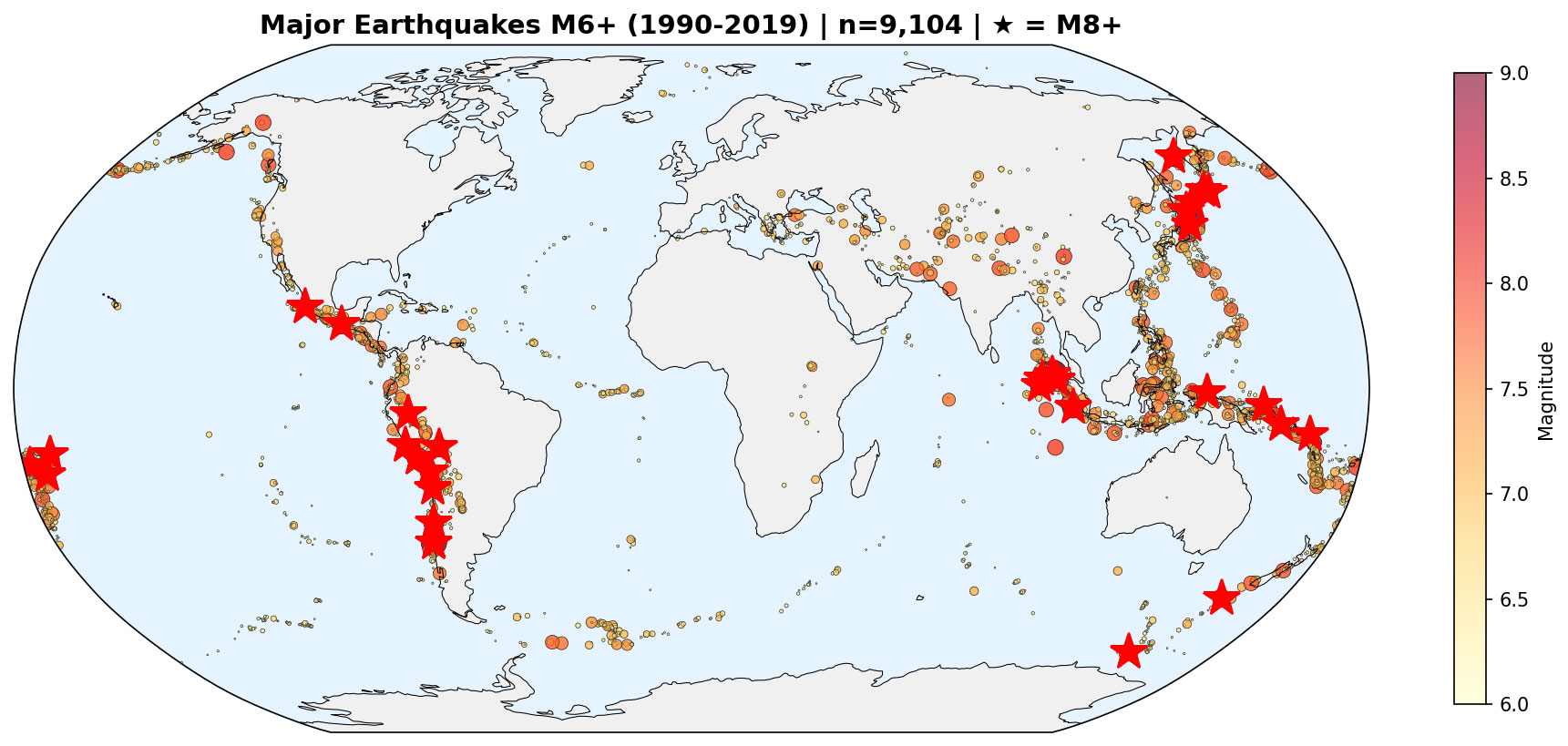
The research, led by Boris Kriuk and Fedor Kriuk, introduces both a novel physics-informed neural network and the Poseidon dataset—the largest open-source global earthquake catalog to date, containing 2.8 million seismic events spanning three decades. The dataset is now publicly available to researchers worldwide.
Unlike conventional “black box” machine learning approaches that ignore the fundamental physics governing earthquake behavior, POSEIDON embeds core seismological laws directly into its architecture. The system incorporates the Gutenberg-Richter magnitude-frequency relationship and the Omori-Utsu aftershock decay law as learnable constraints, ensuring predictions align with established scientific understanding.
“We’ve demonstrated that respecting physics doesn’t compromise accuracy—it improves it,” said Boris Kriuk from Hong Kong University of Science and Technology. “POSEIDON achieves state-of-the-art performance across all prediction tasks while producing scientifically interpretable parameters that fall within established seismological ranges.”
The system simultaneously addresses three interconnected challenges that have traditionally been tackled separately: identifying aftershock sequences, assessing tsunami generation potential, and detecting foreshocks that may precede larger earthquakes. Such unified approach leverages the inherent relationships between these phenomena.
POSEIDON achieved exceptional results in extensive testing, including AUC score of 0.971 for tsunami detection despite these events representing only 1.14% of the dataset—a particularly challenging prediction task due to extreme class imbalance. The system outperformed gradient boosting, random forest, and conventional neural network baselines across all evaluation metrics.
Fedor Kriuk from the University of Technology Sydney emphasized the practical implications: “By achieving both the accuracy demanded by operational early warning systems and the transparency required for scientific trust, we’re bridging the gap between pure machine learning and physics-based approaches in high-stakes geophysical applications.”
The learned physics parameters provide additional validation of the approach. The model’s Gutenberg-Richter b-value converged to 0.752, while Omori-Utsu parameters reached p = 0.835 and c = 0.1948 days—all within ranges established in seismological literature. The convergence to physically meaningful values occurred naturally during training without sacrificing predictive performance.
The Poseidon dataset includes pre-computed energy features, spatial grid indices for efficient geospatial analysis, and standardized quality metrics. Events span the full magnitude spectrum from 0.0 to 9.1, with complete geographic coverage across all latitudes and longitudes.
The research team notes that future work will explore integration of real-time seismic waveform data, extension to continuous probabilistic hazard forecasting, and incorporation of crustal stress transfer physics. The publicly available dataset is expected to accelerate progress in physics-informed seismic research globally.
The findings represent a significant step forward in earthquake prediction, a field that has long struggled to balance the pattern-recognition capabilities of modern AI with the physical constraints that govern seismic behavior. By demonstrating that these approaches can work in harmony rather than conflict, POSEIDON opens new possibilities for reliable, scientifically grounded earthquake hazard assessment systems.