


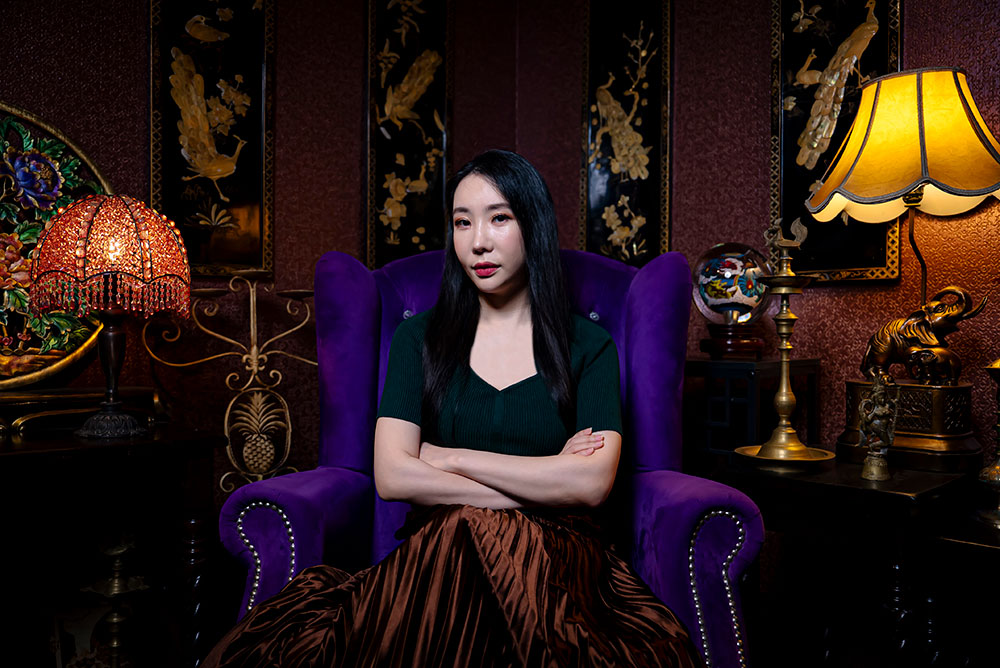

In the sprawling digital landscape of the twenty-first century, few creators navigate the intersection of journalism and new media with the precision of Minyoung (Megan) Lee. Based in the hyper-modern metropolis of Seoul, South Korea, Megan Lee has carved a unique niche that serves as a bridge between Asian realities and a global Western audience. She is not merely a content creator but a journalist who has successfully transposed the rigors of the newsroom into the agile world of independent digital production. As the founder of KMYUL STUDIO and the creative force behind the widely acclaimed platforms Dark Asia with Megan and Beauty and the Beasts, Lee commands an audience of over 1.2 million subscribers, yet her approach remains grounded in the ethical tenets of traditional reporting.
Megan Lee’s career trajectory is the evolving nature of storytelling. Before capturing the attention of millions online, she established her credentials within the high-pressure environment of legacy media. She served as the Chief Producer and Video Team Leader at The Korea Times, where she directed nationally impactful projects including the landmark digital sex-crime exposé on the “Nth Room” case. Her work in that capacity, in collaboration with international outlets like the South China Morning Post, garnered the Video Storytelling Award at the 10th Korea Digital Journalism Awards. These accolades underscore a commitment to investigative integrity that she now brings to her independent ventures.
Her current work is characterized by a distinct duality. On Dark Asia with Megan, she delves into the complexities of true crime, human rights, and social justice within the Asian context, offering English-speaking audiences a rare, culturally contextualized perspective on cases that often go unreported in the West. Conversely, Beauty and the Beasts allows her to explore Asian horror folklore and lifestyle content, merging narrative dread with aesthetic precision.
We sat down with Minyoung (Megan) Lee to discuss her transition from the news desk to the creator economy, the ethical responsibilities of true crime storytelling, and her mission to elevate underrepresented Asian voices in the global discourse. Her journey offers a compelling blueprint for the future of digital journalism, proving that substantive, research-driven content can thrive in an algorithmic age.
Megan, thank you for speaking with us. Your career began in the structured world of traditional media at Arirang TV and The Korea Times. What catalyzed your decision to leave a prestigious role as a Chief Producer to launch KMYUL STUDIO and pursue independent storytelling?
Megan Lee: Thank you for having me. The transition was not a decision I made lightly. Working at The Korea Times and Arirang TV provided me with an invaluable foundation in journalistic ethics, research methodologies, and the technical aspects of broadcasting. I was deeply proud of the work we accomplished, particularly the investigative pieces that shed light on systemic issues within Korean society. However, I began to notice a shift in how audiences consumed information. The rigid structures of legacy media, while necessary for certain types of reporting, often limited the depth and narrative intimacy I wanted to achieve.
I realized that there was a significant gap in the global market. There were many English-language outlets covering Asia, but few delved deep into the human stories, the dark undercurrents of society, or the complex criminal cases with the nuance they required. I wanted to create a platform where I could control the narrative arc, ensuring that stories were told with sufficient context rather than being compressed into a two-minute news segment. Launching KMYUL STUDIO was a leap of faith into the creator economy, but it was driven by a desire to modernize how we tell Asian stories to the world. I wanted to combine the rigor of a newsroom with the accessibility of YouTube, creating something that felt both authoritative and personal.
You mentioned the “Nth Room” case, which was a harrowing investigation into digital sex crimes. How did leading that project shape your approach to the content you now produce on Dark Asia with Megan?
Megan Lee: The Nth Room investigation was a defining moment in my career and my personal understanding of digital ethics. It was a cross-border collaboration involving the South China Morning Post, Tempo Magazine, and others, which highlighted how digital exploitation knows no borders. The case itself was horrific—involving the systematic blackmail and exploitation of women and minors on Telegram. Working on that documentary required a heightened level of sensitivity. We were dealing with victims who had been stripped of their agency and privacy.
That experience became the ethical bedrock for Dark Asia with Megan. It taught me that when you are dealing with true crime, especially cases involving sexual violence or systemic abuse, the focus must remain on the human cost and the societal failure, not just the sensational details of the crime. I learned that “investigative” does not mean “exploitative.” When I research scripts now, I constantly ask myself if the narrative honors the victim and if it serves a public interest. The Nth Room case proved that digital media could be a tool for justice and awareness, not just entertainment. I carry the weight of that responsibility in every video I produce today.
Your channel, Dark Asia with Megan, specifically targets an English-speaking audience. Why do you feel it is critical to bring these specific Asian narratives to the West, and what challenges do you face in translation, both literally and culturally?
Megan Lee: The decision to broadcast in English was strategic and philosophical. Asia is often viewed by the West through a monolithic lens or through the filter of pop culture like K-Pop and anime. While those cultural exports are valid, they do not represent the totality of life here. There are deep societal pressures, historical traumas, and complex legal systems that shape how crimes occur and how justice is—or is not—served.
The challenge is rarely just linguistic translation; it is cultural translation. For example, understanding a crime in South Korea often requires understanding the concept of specific social hierarchies, the intense pressure of the education system, or the cultural stigma surrounding mental health. If I simply translated the police report, a Western viewer might miss the “why” behind the “what.” My goal is to provide that context. I have to explain why a victim might not report a crime due to shame, or why the legal system might seem lenient by American standards. The importance of telling these stories globally is to foster empathy. It reminds viewers that human suffering and the quest for justice are universal experiences, even if the cultural backdrop differs.
True crime is a saturated genre on YouTube. How do you distinguish your content from the vast number of “armchair detectives” who may not have your professional background?
Megan Lee: The distinction lies in the process. I approach every video as a journalist, not just a narrator. Many channels rely on summarizing Wikipedia entries or reading other news articles without verification. At KMYUL STUDIO, we treat each script like a documentary production. This means cross-referencing Korean or local language sources, reading actual court documents when available, and verifying timelines.
Because I have worked in a newsroom, I understand the danger of misinformation. I am very careful about language. I distinguish between allegations and facts. I avoid speculation that could harm living individuals. Furthermore, my tone is deliberate. I avoid the “shock jock” style or excessive dramatization that is common in the genre. My delivery is calm and factual because the facts are usually disturbing enough on their own. I believe my audience appreciates that I respect their intelligence and I respect the gravity of the subject matter. We are discussing real lives, not fictional plot points.
Let’s pivot to your other major platform, Beauty and the Beasts. This channel combines makeup and beauty content with horror folklore. What inspired this juxtaposition, and how does it balance against your heavier investigative work?
Megan Lee: Beauty and the Beasts is my creative outlet for storytelling that is rooted in culture rather than crime. The concept of “Get Ready With Me” videos is huge, but I wanted to twist it. I have always been fascinated by Asian folklore, urban legends, and the supernatural. These stories are a vital part of our cultural heritage. They reveal what a society fears and what it values.
Combining beauty with horror creates an interesting tension. The visual element is aesthetic and calming, while the audio narrative is unsettling. It mirrors the duality of life—beauty and darkness often exist side by side. For me personally, it provides a necessary mental break from the heavy, often depressing reality of the true crime cases I cover on the main channel. Folklore allows for imagination and performance. It allows me to explore the “Beasts” of our mythology while engaging with the “Beauty” aspect of visual presentation. It reaches a different demographic and allows me to showcase a different side of my personality that is less rigid than the investigative journalist persona.
You have a massive combined audience of 1.2 million subscribers. How do you manage the community aspect of your work, and how does audience interaction influence your editorial choices?
Megan Lee: Building a community was one of the most surprising and rewarding aspects of leaving traditional media. In broadcasting, you speak to a camera, and perhaps you see ratings later, but there is no direct dialogue. On YouTube, the feedback loop is immediate. I have viewers from the United States, Southeast Asia, Europe, and beyond. They are incredibly engaged and intelligent.
I listen to them closely. I often conduct polls or read comments to see which cases or topics they are interested in. However, I maintain editorial independence. Sometimes the audience wants a specific sensational case, but if I feel I cannot cover it ethically or if the facts are too murky, I will pass on it. I also use livestreams and Q&A sessions to humanize the process. It is important for them to see that there is a real person behind the narration. The community we have built is respectful and curious. They are not just there for gore; they are there to learn about Asian society. That engagement drives me to keep improving the quality of the production.
Operating KMYUL STUDIO requires you to wear many hats: writer, editor, producer, and host. Can you walk us through the production workflow for a typical episode of Dark Asia with Megan?
Megan Lee: The workflow is intense and cyclical. It begins with case selection. I look for stories that have a broader social implication or a strong narrative arc. Once a topic is selected, the research phase begins. This is the most time-consuming part. I dive into Korean search engines, legal databases, and archival news footage. I have to synthesize hours of reading into a cohesive script that fits a 30 to 60-minute runtime.
Scripting is where the journalism happens. I structure the story to ensure clarity, building the timeline logically. After the script is finalized, I move to recording the narration. My voiceover work is something I take great pride in; it needs to be clear, authoritative, and compassionate. Then comes the visual component. We film the on-camera segments, and then the editing process begins. Editing is where the story truly comes together. We overlay archival footage, graphics, and music to set the tone. As the executive producer, I oversee every cut. It is a full-cycle production that mirrors a television documentary unit, but with a much leaner team.
You have been recognized by The Sun Malaysia, Tatler Asia, and other publications for your influence. How do you define success in the digital space, and does it differ from how you defined it in traditional media?
Megan Lee: In traditional media, success was often defined by prestige, awards, and job titles. It was about climbing the ladder and earning the respect of peers in the industry. While I still value peer recognition—like the award we won for the Nth Room documentary—my definition of success has evolved.
In the digital space, success is defined by impact and sustainability. It is about whether I am shedding light on a story that would otherwise be ignored. It is about whether I can sustain this business independently without compromising my values. When I see a comment from a viewer in Brazil or Germany saying that my video changed their perspective on a social issue in Asia, that is success. It is the ability to influence the global conversation directly. Furthermore, success is having the creative freedom to pursue stories that matter to me personally, rather than being dictated to by a network’s editorial calendar.
Dealing with such dark subject matter—murder, corruption, human rights abuses—must take a toll. How do you protect your mental health and maintain professional distance while immersing yourself in these tragedies?
Megan Lee: This is a crucial question. Burnout and vicarious trauma are real risks in this line of work. Coming from a news background helps because you are trained to maintain a certain level of professional detachment, but you are never fully immune. There are cases that haunt you.
I have established strict boundaries. I try not to work on scripts late at night. I ensure that I have downtime where I disconnect from the news cycle completely. Beauty and the Beasts helps as a creative outlet that is lighter in tone. I also rely on my support system and engage in physical activities to clear my mind. It is important to remember that I am the storyteller, not the subject. To tell the story effectively, I must remain healthy. If I become too emotionally compromised, the quality of the work suffers, and I cannot do justice to the victims.
You are expanding into podcasts and long-form documentary formats. What is the strategic vision behind this expansion, and how does the audio-only format change your storytelling?
Megan Lee: The podcast expansion is a natural evolution. Audio allows for a different kind of intimacy. With video, the viewer is often distracted by the visual elements. In a podcast, the voice is the only instrument. It requires the writing to be even more descriptive and the pacing to be perfect.
Strategically, it allows us to reach audiences who consume content passively—while driving, working out, or commuting. It diversifies the KMYUL STUDIO brand beyond YouTube. We are also looking into IP development. Many of the cases we cover have the potential to be developed into larger documentary series or even scripted adaptations. My vision is for KMYUL STUDIO to be a premier production house for Asian non-fiction content, not just a YouTube channel. We want to be the go-to source for these narratives across all media platforms.
As someone who has worked in both worlds, where do you see the future of journalism heading? Is the creator economy the new newsroom?
Megan Lee: I believe we are seeing a convergence. Traditional newsrooms are trying to become more agile and personality-driven, while independent creators are realizing the need for better editorial standards. I do not think the creator economy will replace the newsroom entirely—we still need large institutions with the resources to cover wars, politics, and breaking news on a massive scale.
However, for feature reporting, investigative storytelling, and cultural analysis, the creator economy is taking the lead. Audiences trust individuals more than institutions right now. They want a guide they know and trust. The future lies in “journalist-creators”—professionals who have the skills of a reporter but the distribution savvy of a YouTuber. This hybrid model allows for more diverse voices and more accountability. It is an exciting time because the gatekeepers are losing their power, allowing people like me to build global platforms from a studio in Seoul.
You mention the “Cultural Bridge” often. Can you give an example of a specific case where cultural context changed the viewer’s understanding?
Megan Lee: A prime example would be the complex defamation laws in South Korea which frequently baffle my Western audience. In the United States or Europe truth is generally an absolute defense against defamation. If you state a fact and you can prove it is true you are typically protected by the law. In South Korea the legal framework prioritizes social harmony and personal reputation over absolute freedom of speech. This means a person can face criminal liability for revealing factual information if it is deemed to be done solely to damage another person’s reputation.
Let us discuss the economics of independent media. You collaborate with sponsors and commercial partners. How do you navigate the ethical tension between monetization and the sensitive nature of true crime or human rights content?
Megan Lee: This is perhaps the most delicate balancing act of my current role. To sustain a professional studio with high production values, I need revenue. We have costs for equipment, software, travel, and research resources. However, placing a commercial advertisement in the middle of a story about a tragedy requires extreme tact. I have developed a rigid ethical framework for sponsorships at KMYUL STUDIO.
First, we vet our partners rigorously. I refuse to work with companies that do not align with our values. You will never see me promoting gambling apps or dubious financial schemes. Second, I am very deliberate about ad placement. I never place a mid-roll advertisement during the climax of a harrowing story or immediately after describing a victim’s suffering. That would be disrespectful. I usually group sponsorships at the beginning or the very end of the video or during a distinct segment break where the tone shifts naturally.
Transparency is also vital. My audience understands that this is my job. They know that the revenue from these partnerships allows me to remain independent and not rely on clickbait for views. I view the sponsors as patrons who fund the journalism. As long as the product is legitimate and the placement is respectful I find that the audience is supportive. They want the channel to survive and thrive. Ultimately, the goal is to ensure the commercial aspect never overshadows the human story. The story always comes first.
As a female founder and former Video Team Leader in a traditionally male-dominated media landscape in Asia what unique challenges have you faced and how has your identity influenced your storytelling?
Megan Lee: The media landscape in Asia like many industries here has been traditionally hierarchical and male-dominated. When I started my career asserting my voice in a room full of senior male editors required resilience. There is often an expectation for women to be softer or to cover “lifestyle” topics rather than hard investigative journalism. Breaking out of that box to lead a video team and direct investigative documentaries like the Nth Room project was a constant process of proving my competence.
However, I view my identity as a woman as a distinct strength in true crime storytelling. Many of the cases I cover involve violence against women domestic abuse or sexual exploitation. As a woman, I can approach these narratives with an inherent empathy that perhaps some male reporters might miss. I understand the subtle fears women live with daily, the fear of walking home alone at night or the fear of digital surveillance. This shared experience allows me to write scripts that validate the victim’s experience rather than treating it clinically.
Looking forward to what is the ultimate ambition for Dark Asia with Megan and KMYUL STUDIO? Do you see yourself returning to traditional television or do you believe the future remains in building your own IP?
Megan Lee: My ambition is to build KMYUL STUDIO into a comprehensive media entity that stands on par with major production houses but retains the agility of a digital creator. I do not see myself returning to traditional television as an employee. The freedom I currently possess to choose my topics and dictate my creative direction is too valuable to give up. However, I do foresee collaboration.
We are actively exploring opportunities to adapt our original research and storytelling into larger formats such as streaming series or documentary features for platforms like Netflix or Disney Plus. The intellectual property we are building is significant. We are documenting parts of Asian history and criminal justice that no one else is covering in English.
I want Dark Asia with Megan to be more than a YouTube channel. I want it to be a repository of record. Ten years from now, I want researchers and viewers to look at our library as a definitive archive of this era in Asian society. We are also looking to expand our team to include more investigative journalists and translators, allowing us to cover not just Korea but deeper stories in Japan, Southeast Asia, and China. The goal is to be the primary bridge for Asian non-fiction storytelling globally. I am building a brand that can outlast any single platform.
Finally, Megan, if you could summarize the core message you hope a new viewer takes away from your body of work, what would that be?
Megan Lee: If a new viewer watches my content, I hope they take away a sense of shared humanity. It is easy to look at a crime in a foreign country and think of the people involved as characters in a drama or as “others” who are fundamentally different from us. My goal is to shatter that distance.
I want them to realize that the grief of a mother in Seoul is the same as the grief of a mother in New York. I want them to see that the fight for justice against corruption or negligence is a universal struggle. We are all navigating the same human condition just under different cultural skylines. If my storytelling can foster that empathy and make the world feel a little smaller and a little more connected, then I have done my job. Storytelling is not just about recounting what happened; it is about understanding why it matters. That is the mission of KMYUL STUDIO, and that is my promise to my audience.
About the Interviewee:
Minyoung (Megan) Lee is the Founder and Executive Producer of KMYUL STUDIO, based in Seoul, South Korea. A former Chief Producer at The Korea Times and anchor at Arirang TV, she is an award-winning journalist known for her work on the “Nth Room” digital sex crime investigation. She currently hosts the hit digital platforms Dark Asia with Megan and Beauty and the Beasts, reaching over 1.2 million subscribers globally.
Connect with Megan Lee: YouTube: Dark Asia with Megan | Beauty and the Beasts Website: KMYUL STUDIO Social Media: Instagram @leemeganida | TikTok @batbeasts