


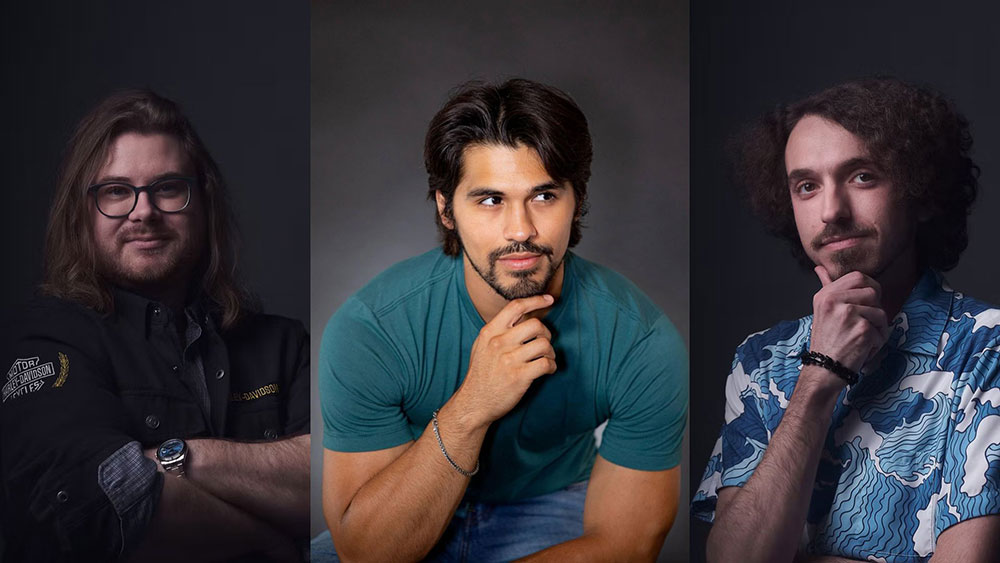

Mentorship has played a defining role in Abraham Mejorado’s development as both a producer and actor. While ambition and discipline formed the foundation of his career, guidance from experienced professionals helped refine his understanding of the industry, shaping not only how he works but also how he thinks about longevity, collaboration, and responsibility within filmmaking.
Two figures stand out as especially influential in that journey: Omar Parker and Charles Burt. Parker and Burt have known each other since 2015, when they attended Montana State University together. Since then, the pair have collectively produced more than 50 titles, with work screening at major international festivals including Cannes, Sundance, TIFF, and Tribeca. Their careers span both digital-first production and traditional festival-driven filmmaking, offering a rare blend of perspectives that proved formative for Mejorado.
Mejorado first met Parker while working behind the scenes for a top 100 YouTuber. At the time, he was serving as a production assistant on Parker’s projects. According to Parker, Mejorado immediately distinguished himself through intensity, curiosity, and reliability.
“He was always the first one there and the last one to leave,” Parker said. “He picked things up incredibly fast. You could explain something once, and he would never forget it. Most importantly, he genuinely wanted to learn.”
Under Parker’s mentorship, Mejorado gained hands-on experience across departments, learning not just how tasks were executed but why decisions were made. Parker emphasized efficiency, communication, and maintaining a healthy, non-toxic set environment. As trust grew, Parker introduced Mejorado to Charles Burt, expanding his exposure to more traditional filmmaking disciplines.
Burt added a crucial layer to Mejorado’s education. With deep experience in classical photography, film reels, and festival strategy, Burt helped bridge the gap between digital production and legacy filmmaking practices. Through him, Mejorado developed a respect for film history, visual discipline, and long-term career planning, learning that sustainability in the industry requires patience as much as ambition.
Today, all three are collaborating on The Prince, The Sister & The Serpent, a two-million-dollar dark fantasy feature based on the myth of Cadmus. The project represents a synthesis of their collective experience, blending modern digital workflows with classical storytelling and disciplined production culture.
One lesson that left a lasting impression on Mejorado came from a story Parker frequently shared. You can teach most people how to do most film jobs, Parker would say. But if you are spending three months in the Arctic, you would rather work with someone professional and enjoyable than someone more experienced who is impossible to be around. That philosophy fundamentally shaped Mejorado’s approach to collaboration.
He considers interpersonal skills and dependability among his greatest assets. Being approachable, prepared, and consistent opens doors that talent alone often cannot. For those entering the industry, Mejorado emphasizes that relationships matter as much as craft. Skills can be learned. Trust must be earned.
Those same values extend into Mejorado’s growth as an actor. Unlike performers who arrive through traditional conservatory pipelines, his acting career evolved organically from production work. Early on, he approached acting with intensity, immersing himself in classes and method-based techniques centered on emotional recall and prolonged character immersion.
A formative conversation with Parker prompted a reevaluation. He was asked a deceptively simple question: What kind of actor do you want to be? At the time, Mejorado was deeply invested in methodological approaches. Over time, however, exposure to larger, commercially oriented productions reshaped his perspective. On professional sets, efficiency mattered. Consistency mattered. Acting was no longer an isolated pursuit, but one part of a much larger machine.
He developed a growing respect for actors in the mold of Clint Eastwood, performers who arrive prepared, step into character efficiently, deliver what the story requires, and step out without excess. To Mejorado, this restraint represented professionalism rather than diminished artistry. Emotional accessibility on demand, without indulgence or disruption, revealed itself as a different and equally demanding form of mastery.
This philosophy informs his portrayal of Cadmus in The Prince, The Sister & The Serpent. Rooted in ancient myth, the role could easily drift into abstraction or theatrical excess. Instead, Mejorado approaches the character as emotionally grounded and human, allowing vulnerability and contradiction to carry the performance. The ensemble cast, which includes Wayne LeGette, James Smillie, Madison Brunoehler, and Constantine Gregory, supports a production culture built on clarity, collaboration, and respect.
Restraint is a recurring theme in his advice to younger actors. One of the most common mistakes he observes is confusing intensity with dedication. Overacting, forcing emotion, or prioritizing appearance over listening often undermines authenticity. Acting, he argues, is less about demonstrating range and more about responding truthfully within the moment. Silence, stillness, and hesitation frequently communicate more than dialogue.
Preparation, rather than prolonged emotional immersion, remains central to his process. Understanding objectives, relationships, and stakes before stepping on set allows actors to remain present and flexible once cameras roll. Professionalism, being on time, knowing lines, and respecting the crew are non-negotiable. Reliability, in his view, is often the difference between opportunity and obscurity.
That same pragmatic mindset shapes Mejorado’s broader philosophy about the future of filmmaking. Having built his career producing digital content for creators with tens of millions of followers, he brings a rare audience-first perspective to film. Online platforms taught him early that attention is earned, not assumed, and that audiences decide quickly what succeeds.
Rather than resisting streaming platforms, AI tools, or evolving workflows, Mejorado sees them as natural extensions of cinema’s evolution. Each technological shift, from sound to color to digital, was initially met with resistance. In his view, technology does not replace artistry; it expands what is possible when used responsibly.
This belief is embedded in The Prince, The Sister & The Serpent, which blends traditional production techniques with modern digital and AI-assisted workflows. The technical team, drawn from AAA video game cinematics, contributes digital precision while honoring classical narrative structure. For Mejorado, everything is simply a tool in service of one goal: entertaining the audience.
Underlying all of his thinking is a commitment to sustainability. Careers are not built on single films, but on consistency, discipline, and adaptability. By integrating mentorship, professionalism, audience awareness, and evolving technology, Abraham Mejorado is carving out a model for modern filmmaking that values both craft and endurance. His IMDb profile can be found here.